


Director of Education Rita Russo sees Edsby as the thread that connects her 34,000-student district
Kawartha Pine Ridge District School Board (KPR) is a mixed rural and urban district spanning roughly 7,000 square kilometres around Peterborough, Ontario, Canada serving 34,000 students and 3,450 staff across dozens of schools. Running a district that size means a lot of systems, and a concerted effort for a single surface to ensure none of them leave a stakeholder group behind.
For Rita Russo, Director of Education and CEO at KPR, that’s the lens the Edsby digital learning platform for K-12 gets evaluated through: not as a single feature or a single win, but as the thing that finally let every group in the district — students, staff, and families — show up in the same place. Rita said, “When you see all of your stakeholder groups engaging with one tool, you know you chose the right tool.”
“I think the key issue that Edsby brought a solution to was everything in one place for students, for staff, and for families. And so I would say that that’s been by far the biggest value that we have seen with Edsby as our platform.” — Rita Russo, Director of Education & CEO, Kawartha Pine Ridge District School Board
A District That Outgrew Its Old Tools
Standardizing on Edsby didn’t happen by accident.
Back in 2014, before Edsby, KPR’s teachers had been assembling their own patchwork of free social media and web tools to fill gaps the district’s official systems couldn’t cover. It was workable in the moment, but a headache for data ownership, privacy, and consistency at the district level. Meanwhile, the information staff needed most, held inside the district’s student information system (SIS), was locked away from the people who needed quick, everyday access to it: teachers in their classrooms.
They needed a solution that would give staff instant access to the information they needed. They needed to focus on finding a better, single platform for communication and collaboration. One that wasn’t just focused on teacher/student communication, but that would allow parents a better way to be involved with their school.
Solving that gap meant asking harder questions than “what’s easiest to roll out.” It meant weighing on-premises infrastructure against cloud delivery, working out backup and disaster recovery, and figuring out how a cloud platform would integrate with a SIS the district had spent years locking down. Adopting a system like this would be the biggest project KPR would deploy at their school district.
Privacy As a Starting Condition, Not An Afterthought
For a system meant to reach every family in the district, trust wasn’t optional. KPR’s leadership was clear that any new platform had to meet the same bar of care the district already held itself to around student data.
“I think it’s really important for us to be able to say it is stored locally. That matters to parents, that matters to caregivers, it matters to staff, it matters to every user in the system, and students as well,” said Rita, reflecting on Edsby’s guarantee that KPR’s live, production data, and all backups, would always reside in provincial Microsoft Azure data centers.
Dan Fitzgerald, CIO, KPR agreed. “We had to look at the needs of all of our stakeholders. And from the parent’s perspective, privacy around the data was critical. The info we have in our SIS is very secure in its current format, but bringing it into a more open format and different platform meant making sure we still had the same rules, roles and controls in limiting access to confidential information.”
That standard is one Rita Russo still points to directly when she talks about what makes Edsby trustworthy at the scale KPR operates at.
A Rollout That Became a Movement
KPR built out more than 100 requirements before it ever issued a request for proposal, pulling in input from teachers, students, school offices, and parents alongside its technical teams. Edsby scored highest among vendor submissions and ran a successful two-month pilot across four schools: two high schools and two elementary.
The district-wide rollout that followed didn’t go the way anyone planned. A labour situation forced KPR to abandon a phased introduction and open Edsby to every school at once, framed simply as a year of exploration rather than a mandate.
What could have been a liability turned into the opposite. Teachers found Edsby on their own terms, and word spread school to school.
By allowing teachers to discover Edsby on their own, it led to grass roots adoption. It progressed into a teacher-driven implementation. Teachers embraced the solution as a new and modern way of collaborating. Teachers who are normally reluctant to use technology were finding it easier to use than any other platforms in the past. Principals said Edsby gave them more direct access to their staff and parents in the community.
Scott Johnson, Principal at Campbellford District High School and a member of the committee that first evaluated portal platforms for the district, saw that same shift play out at the school level. “In Edsby, everything is in one fast, easy-to-get-to place. If I want to see a student’s report card, see their work in a class, send a message to their parents, all those things are right there. I only need one mobile app or one desktop screen. I use it many times a day, whenever I’m speaking with students or parents. And Edsby helps me solve problems even when I’m not in the building. I can get to it from my phone in the parking lot, from my desk or from home.”
Built Into the Way the District Actually Works
What began as a portal has become infrastructure. Russo found the integration with KPR’s SIS deep enough that it changed her own daily habits as the district’s top administrator. “There are so many things that the Edsby platform does for you that others just simply don’t. The integration with the SIS system for us has been seamless, and the Edsby user experience I would say is outstanding.”
That ease of use is what Russo credits for the platform sticking with staff long after the novelty of the rollout wore off, including teachers who came in skeptical of new technology.
“Edsby is intuitive. The digital world that we’re in, with the social media tools that we have, can be overwhelming. Edsby allows users to feel confident they can engage with all of the tools offered to them.” — Rita Russo, Director of Education & CEO, KPR
Edsby has become the anchor for everything else KPR runs in the cloud. It is less a single tool among many and more the front door to all of them. It encourages parent engagement in a way that other platforms struggle to offer. Many parents wanted to be more involved, and with Edsby, they can, all in one place.
“Edsby really is now the core of our cloud strategy,” said CIO Fitzgerald. “Edsby has allowed us to easily integrate all our cloud services through one portal by bringing in all the excellent online resources that are available today to our students and parents. It adds that cohesion we’d needed.”
A True Partnership
Ask Russo what’s made the platform work long-term at KPR, and the answer isn’t just the product — it’s the relationship with the people behind it.
“The beauty of the partnership with Edsby has been around how open they are to hearing our feedback and to helping to build better together with us. I would say it’s a key hallmark of the relationship. Working alongside them has helped ensure students, staff and our families have a positive experience. I’m grateful for our work together.” — Rita Russo, Director of Education & CEO, KPR
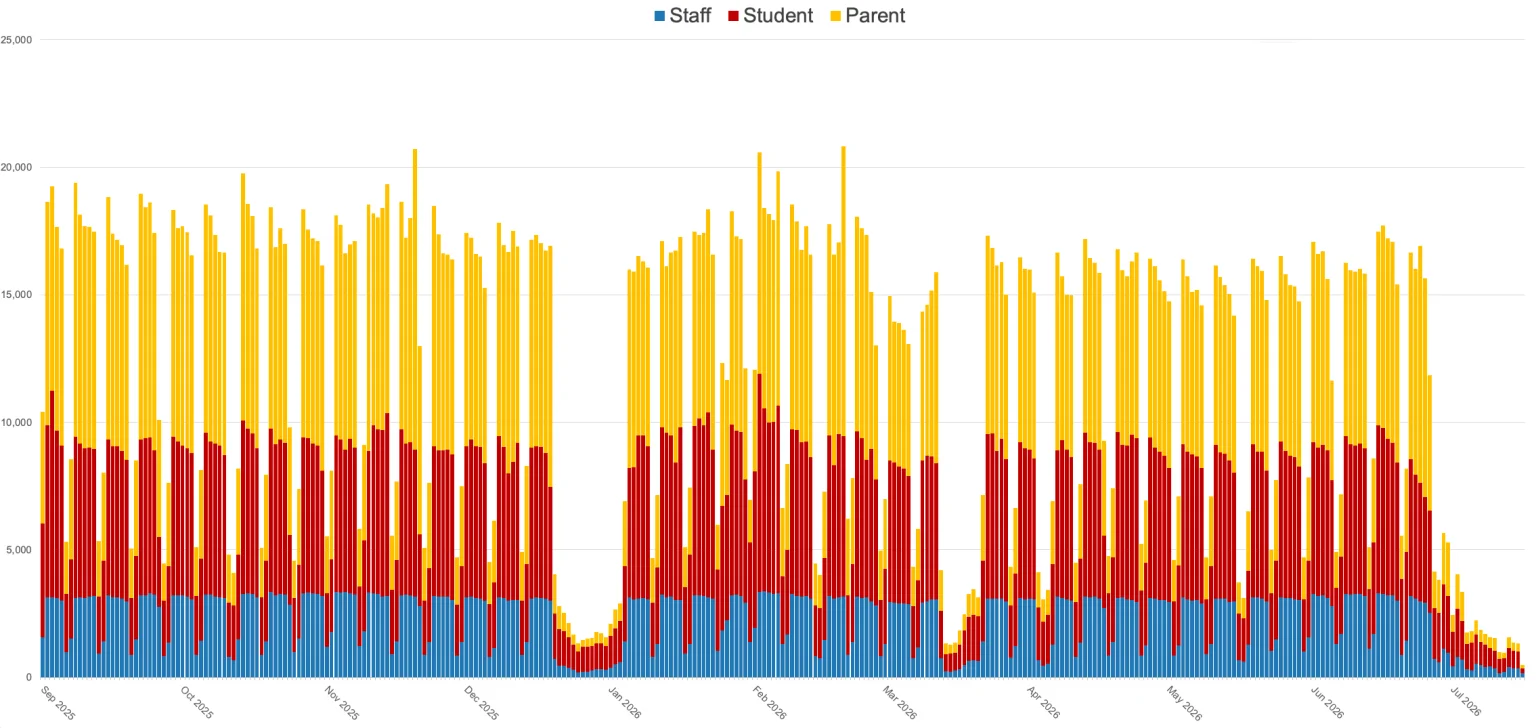
Observations:
- Virtually all district staff use Edsby every day – The district has 3,450 staff. Most log in daily.
-
Student use is exceptionally high – Out of a student body of 34,000, about a third of students use the system every day. Considering early years students (K–3) do not independently log into learning tools, daily use among the eligible middle and high school students is exceptionally high.
-
High parent engagement – Unique parent logins track close to student numbers, averaging 10,000 to 12,000 users. Parents are actively co-managing workloads, checking attendance and academic progress.
- Usage that mirrors the weekly academic rhythm
- Five Day Cycle – Edsby usage tracks a clear weekly rhythm. Each week is clearly visualized by clusters of 5 high, dense vertical bars representing Monday–Friday.
-
Mid-Week Focus – Friday usage often tapers as the weekend approaches, immediately followed by a deeply recessed bar for Saturday … but with elevated use on Sundays, or the ends of 3 day long weekends, as students and teachers log back in to prepare for the week ahead.
- Usage that mirrors the district’s annual academic cycle
-
Multiple “Peaks” – The year begins with an aggressive ramp-up in September/October as classes establish digital routines, reaches an annual zenith in November (mid-term assessments), dips for winter, and surges again to a sustained secondary plateau from February through May.
- Winter Break – The most distinct visual footprint on the chart is the massive, u-shaped canyon spanning late December to early January. Yet traffic never hits absolute zero. A thousand or more students still use Edsby in the district every day in the quietest time of the year. There is a clear ramp up as the holiday ends, with teachers and students checking schedules and preparing materials ahead of the return.
- Spring Break – A smaller, secondary gap appears over March Break when, like the Winter break, some district students still log into Edsby every day.
- Summer Fade – June shows a steep decay in traffic down toward baseline levels as courses wrap up, assignments cease, and the academic calendar draws to a close.
-
